














COOL, WITH A CAUSE
46664 was Nelson Mandela's prison number. Mr Mandela is a global icon because of his long struggle for freedom, equality and social justice. A digital imprint of his hand is engraved on every bangle.

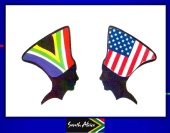



Following the first free and fair democratic elections in 1994 the United States (USA) and South Africa established a Bi-National Commission (BNC) led by former South African Deputy President Thabo Mbeki and then US Vice President AL Gore in an effort to enhance bilateral co-operation.
In 2000, the US government reassessed the BNC and opted to change the focus of the relationship by shifting the emphasis from principals and frequent high level political involvement to technical work of committees. Subsequently the structure of engagement established was the Annual Bilateral Forum (ABF). The ABF serves to evaluate bilateral interactions and co-operation, identify the challenges faced and map the way forward.
Bilateral cooperation in counter-terrorism, combating HIV/AIDS, and military relations has been particularly positive. The US is the largest single donor of health assistance to South Africa, partly through the President’s Emergency Fund for Aids Relief (PEPFAR).
Through the US Agency for International Development (USAID) and the Peace Corps the United States provides assistance to South Africa to enable the country to meet the set developmental goals. South Africa is one of the major beneficiaries under the African Growth and Opportunity Act (AGOA) which allows African countries to export duty free to the US.
South Africa and the US signed a Nuclear Energy Research and Cooperation Agreement in Vienna on 14 September 2009 aimed at facilitating cooperation in advanced nuclear energy systems and reactor technology. This agreement is geared towards promoting collaboration between the two countries in research and development of advanced reactor technologies as well as expanding efforts to promote and maintain nuclear science and engineering infrastructures.
In April 2010, H.E. President Jacob G. Zuma, President of the Republic of South Africa and other world leaders participated in a Nuclear Security Summit, hosted by President Obama in Washington DC. Alongside the Nuclear Security Summit, Secretary of State Hilary Clinton and South African Minister of International Relations and Co-operation, Ms Maite Nkoana Mashabane, launched the South Africa-United States Strategic Dialogue.
The SA-US Strategic Dialogue provides an opportunity for both countries to further enhance political ties as well as consolidate economic partnerships. It also provides a platform for effectively addressing issues of mutual concern such as food security, the peaceful resolution of conflicts in Africa and other parts of the world, spreading democracy around the world, continuing to combat HIV/AIDS and other communicable diseases, economic development, nuclear energy cooperation and climate change.
The United States is one of South Africa’s three largest trading partners and it is within this context that we shall work to increase SA –US trade relations in the Midwest and grow investment both outward and inward to the highest possible levels.

Heat beat Celtics with score 98:79, which have corrected the total score into 3 to 3. In this game, Bosh played for 28 minutes, although the time is twice as long as the t
nfl jerseysime of last game, he only got 7 points and 6 rebounds, which showed low efficiency.
Bosh was injured in the second round, all have absented for 9games. The return of la
nfl jerseys wholesalest game, only played for 14, he got 9 points and 7 rebounds which showed the higher efficiency. But at the key moment, he changed Bosh with Haslem which made him dissatisfi
cheap jerseysed.
As for the question, Spoeltra thought that he had absent for a period of time and let he playing at that time is unsuitable. But this time, Spoeltra have increase hi
jerseys mlbs time, but he did not repay with excellent performance.
In the same time, his times of shooting was pretty few, only 8, which is not in accordance with the status of hi
jerseys for cheapm.
Today is AI 's birthday of 37 years old. He has left NBA for 2 years.
Two years, which can change more things, such as Kobe, he can stand at peak of honor 2 years
nfl jerseys wholesaleago, but now he had no choice but accept the result of elimination. Of course, we must define more accurately that have left the stage of perk of 11 years. In 2001, h
jerseys mlbe brought 76ers into the stage of Finals, while they were beat by the Lakers which was in his peak. In 2012, we saw AI again in the Philadelphia, he still had not any
cheap nfl jerseys free shipping change, while he is changing from the old boy to a spectator.
Nothing is immortal, AI is still here, but the things about the story of his Philadelphia is thorough
new nfl jerseysly ending. All the memory about him will deeply leave forever at our brain. As soon as we saw him, we are still felt very passionate, and it only possess by him ----
cheap nfl jerseysAI.
In the fourth game, James did not take the last shooting and pass to Haslem who had finally missed, so lost. In today's game, James played excellent performance before the fou
cheap nfl jerseys free shippingrth game, when game was into the key moment, he disappeared again.
All of which put him under the condemnation of comprehensive fans. While now the total score is 2 to 3, th
jersey storee dream of champion is far away from them. Maybe Heat will be eliminated by Celtics and out of the game of champion again, which is apparently that James can not accept failur
new nfl jerseyse again.
He once left the Cavaliers, which made him suffered constant abuse and condemnation from the public, more seriously is that he was detested bitterly by fans of Cav
football jerseysaliers. What he pursues only the champion, but it seems that he is not able to realize the dream.
But he should not suffered this 'treat", the pressure he beats is more hea
nfl jerseys cheapvy.